We decided to take the slightly longer route today because we would like to choose the shorter route tomorrow because we will be moving to our next accommodation on Saturday. The weather promised us less drizzle and more dry periods today. 😊
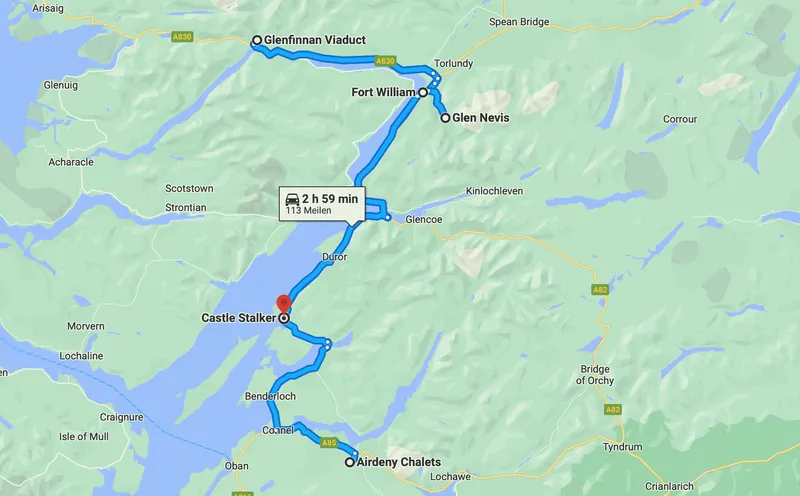
The first big goal today is the Glenfinnan Viaduct and for that we have to leave our house promptly at around 8 a.m. We really want to be able to stand at the Glenfinnan Viaduct when the famous Jacobite Steam Train passes by. Since he only does this four times a day, it would be good if we could do it on the first attempt so that we could spend the rest of the day freely and without looking at the clock.
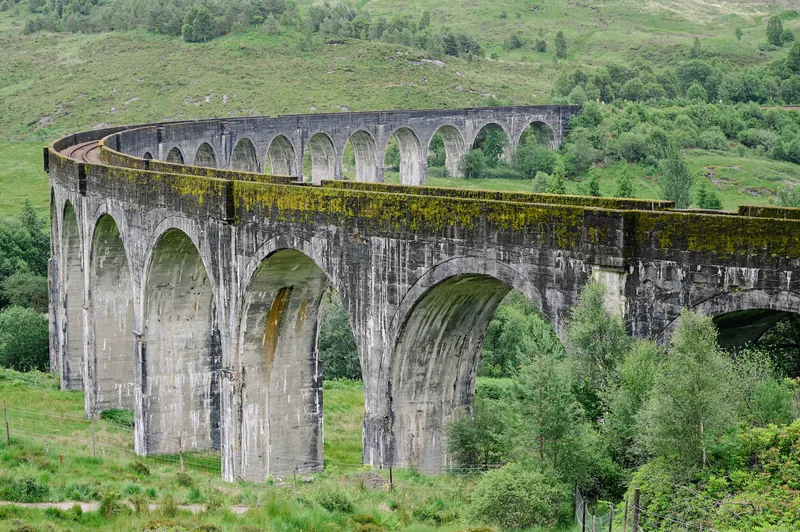
Glenfinnan Viaduct
If you don't immediately think of Harry Potter when you think of the Glenfinnan Viaduct or the Jacobite Steam Train, we still have the keyword "Hogwarts Express". 🧙🏻♂️🪄 We already noticed at the airport that we have many die-hard Harry Potter fans on board.
After about 1.5 hours of driving we reach the parking lot in front of the Glenfinnan Viaduct and now we also know why it is recommended to be here about an hour before the Jacobite Steam Train. Although the parking lot is really large and offers plenty of space for guests, it fills up quite quickly and hordes of tourists make their way to the viaduct.
We also take the path and climb part of the slope to secure a good place for the “Hogwarts Express”. Valentina wonders what all the people are doing here and what are they waiting for? - Does the answer that everyone here is just waiting for a train to pass seem a bit strange to you? 😏
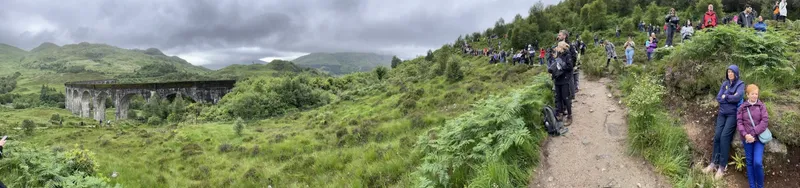
With a few minutes delay you can now see the first clouds of white smoke appearing in front of the Glenfinnan Viaduct and the groups of people start to clap, rave and totally celebrate this magical moment. The Hogwarts Express rushes past us with lots of smoke and beeps.
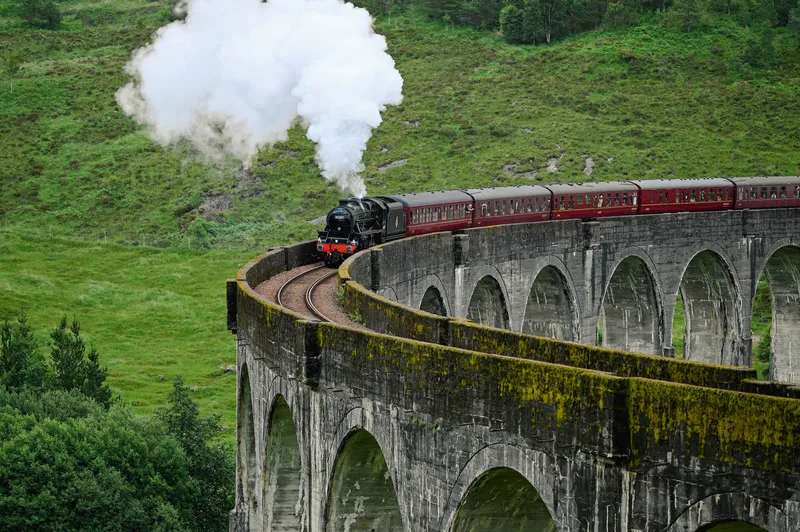
"Hogwarts Express" for Harry Potter fans
Inside the carriages, the passengers wave wildly out of the window and from the slope next to the viaduct the other group waves to the train passengers and sends kisses. After just a few minutes you can no longer see much of the Hogwarts Express and a big cheer breaks out. Beaming faces now set off again to descend the somewhat muddy and wet route, with the good feeling of having seen the Hogwarts Express in time.
The Glenfinnan Viaduct car park begins to empty quickly & queues of cars make their way to other viewing areas. - And in 2 hours the whole thing starts again!! 😅
Super funny moment. There was also a couple that we had with us on the plane from Cologne to Edinburgh. With all the delays, waiting for suitcases, etc., a group quickly formed on Sunday consisting of several people and families with whom we waited and helped each other. And exactly this one couple suddenly stands in front of us on the way back to the car. 🙂 So Scotland is a "village" after all, because if we had decided to take this exact day and time, we certainly wouldn't have met all these people. We chatted briefly about the last few days and wished each other a great trip. Maybe we'll see each other again.
💡 Interesting facts about Glenfinnan Viaduct and the Hogwarts Express🧙🏻♂️
Glenfinnan is a small town in the Highlands on Loch Shiel with around 100 inhabitants. It lies between the towns of Fort William and Mallaig, which have been connected by a railway line since 1901. It is precisely this railway line, the “Glenfinnan Viaduct”, that has given Glenfinnan a huge increase in attention from visitors and tourists since the Harry Potter films. In many episodes the “Hogwarts Express“ the spectacular backdrop of the “Glenfinnan Viaduct” against the backdrop of the hilly landscape, with cloud-drenched peaks and Loch Shiel.
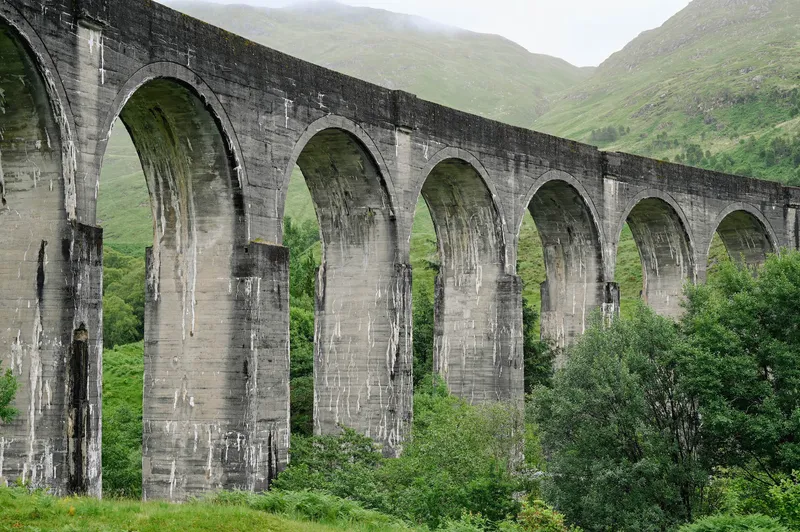
But even without the Harry Potter films and the “Jacobite Steam Train” used for tourist trips, the Glenfinnan Viaduct is a revolutionary structure for its time. The Glenfinnan Viaduct was built between 1897 and 1898 and is 380 meters long, rests on 21 arches and is up to 30 meters high. What was sensational at the time was that only concrete was used for such a building. The builder was Robert McAlpine, who received a knighthood for this building. He was also given the nickname “Concrete Bob” by the people.
Today, freight trains no longer run over the “Glenfinnan Viaduct”, as they once did for the fishing industry. Diesel railcars are used to transport passengers and the special tourist train “The Jacobite”, a museum train pulled by steam locomotives, is used every day.
In and around Glenfinnan there are other attractions besides the “Glenfinnan Viaduct Trail”. The Glenfinnan Monument is located directly on the shore of Loch Shiel. It was built to commemorate the Second Jacobin Rising, which began on this site in 1745.
The Glenfinnan Station Museum is also an attraction and offers a café and overnight accommodation in old railway carriages.
Glenfinnan Monument
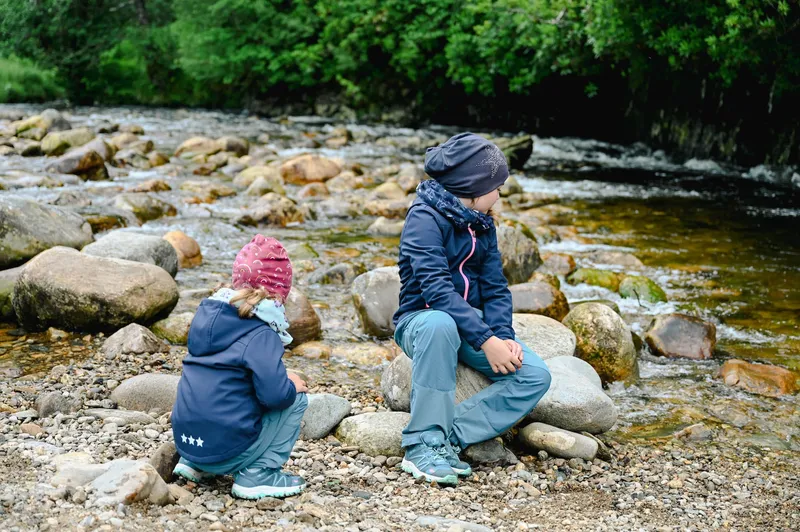
We stay briefly near the viaduct and go to the shore of Loch Shiel where the Glenfinnan Monument is located. Here you can take another explorer route through a natural area. The water of Loch Shiel has attracted us again and we simply skip small stones across the water for a while.
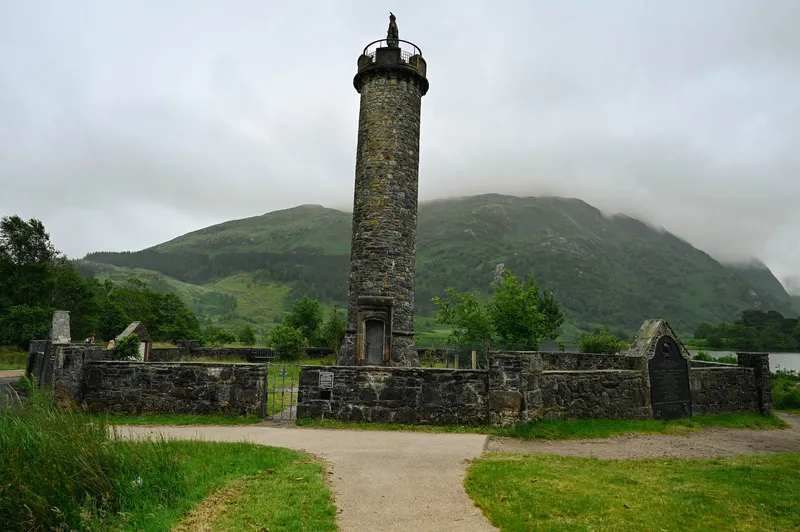
Glenfinnan Monument on the banks of Loch Shiel
Detour to Fort William
Our second stop today is Fort William, because we want to take a look around the center and use this to have lunch. So we stroll around the center for a bit and finally decide on a really rustic tavern with traditional food. The place reminds us a little of the many pubs we visited in Dublin two weeks ago.
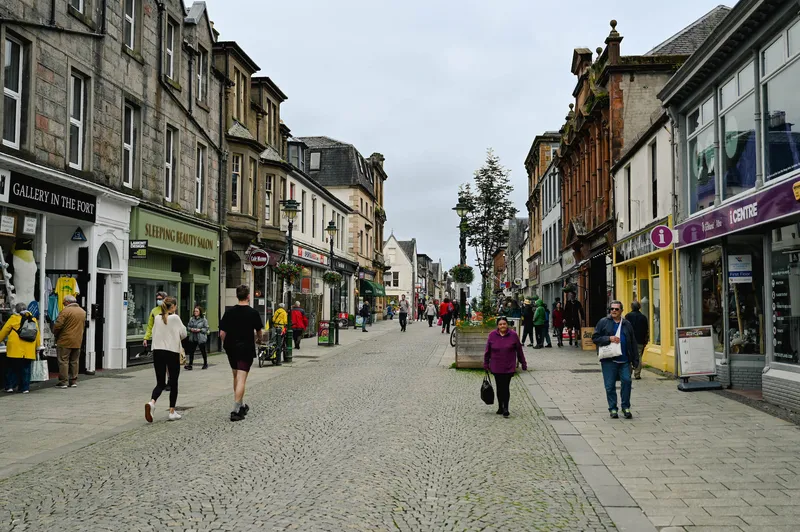
💡 Interesting facts about Fort WilliamThe largest city in the western Scottish Highlands is Fort William with around 5,900 inhabitants. It is located at the southern end of the Great Glen fault, which divides the Scottish Highlands into the Grampian Mountains and the Northwest Highlands. Idyllically located on the banks of Loch Linnhe and with a view of the highest mountain in Scotland and the whole of Great Britain, the 1,345 meter high “Ben Nevis”, Fort William is considered a tourist hotspot.
Fort William has numerous outdoor shops on its High Street, as well as many cafes and restaurants. The “West Highland Museum” provides clear information about the history of Fort William and is free to visit.
Many mountain hikers and mountain climbers use Fort William as a starting point for “Ben Nevis” and its surroundings. The area around Loch Linnhe can be easily explored on numerous hiking and cycling trails. Non-hiking enthusiasts also have the opportunity to take the “Nevis Range” cable car up to the 655 meter high “Aonach Mòr” and enjoy the magnificent view.
Many routes are also ideal for mountain bikes and some are among the best in the world. In the summer, it's the beaches and hiking trails that attract visitors to Fort Williams. In winter it is the ski areas that invite you to enjoy a variety of winter sports.
The tour with the legendary Jacobite steam train, which many know as “Hogwarts Express” from the Harry Potter films, also begins in Fort Williams. The tour is 135 km long and takes you past “Loch Morar”, the deepest freshwater lake in Britain.
Glen Nevis Valley
After fortifying ourselves with a really tasty lunch, we drive only about 2 miles further into the Glen Navis valley and hike along a route here. With a view of Ben Nevis, we enjoy the intense green that sprouts around us. At 1345m, Ben Nevis (Ben = mountain, Glen = valley) is the highest mountain in Scotland.
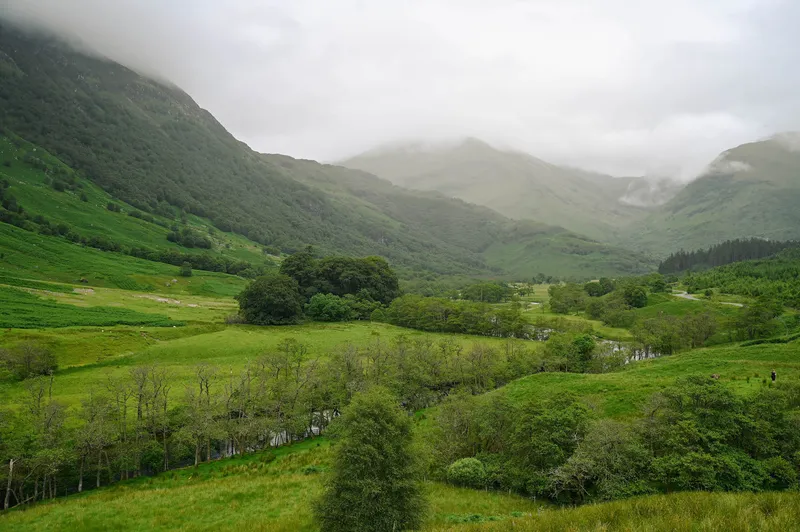
The Glen Nevis valley is one of several valleys in the Scottish Highlands. Together with the River Nevis, it is an exciting hotspot for hikers and tourers. Most routes leave directly from the Glen Nevis Visitor Center, where we also start. With the girls we do one of the smaller routes. At this point we also have to say that the girls are really brave and have an immense “explorer spirit”. They run and hike every path and really have a lot of fun exploring everything. 🙌🏼
💡 Interesting facts about the Glen Nevis ValleyIn the “Council Area Highland” southeast of Fort Williams is the Glen Nevis valley. It lies at the foot of Scotland's highest mountain “Ben Nevis” and the River Nevis flows through the valley. The river then ends in Loch Linnhe near Fort William.
The Glen Nevis valley is divided into 2 sections by a narrow gorge. The lower valley section runs south and west of the mountain “Ben Nevis”. The “Glen Nevis Visitor Center” set up by the council area and also the Fort William youth hostel are located there.
The upper valley section of Glen Nevis is bordered by mountains such as Aonach Mòr and to the north by the foothills of “Ben Nevis”. South of the upper section of the valley is the Mamores mountain range, which reaches a height of 1,132 meters with its highest peak, “Binnein Mòr”.
Following the flatter section of the valley, you reach the highest and loneliest train station in Great Britain, “Corrour Station”. This section of the valley is particularly spectacular with several waterfalls and the cascades of “Steall Falls”.
The “Steall Falls” is the second highest waterfall in Scotland and the water falls from a height of 120 meters. The “Steall Falls” was also used several times as a film set in the Harry Potter films. Tourists can only reach the “Steall Falls” on foot, using an adventurous three-cable bridge to cross the River Nevis. The Glen Nevis Valley is a popular excursion and hiking destination due to its scenic beauty, with Fort William often serving as a starting point.
Braveheart movie set
After a ride through nature, we drive our speedster a little further and finally come to the Braveheart film set. You can't see much here, but die-hard Braveheart fans might recognize this hill here.
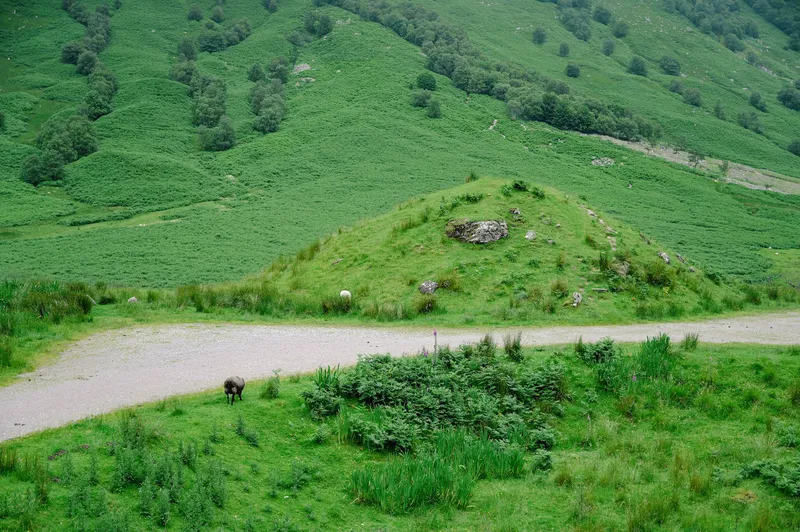
Braveheart film set in the Glen Nevis Valley
Castle Stalker Viewpoint
On the way back home we take the Castle Stalker Viewpoint with us. You can only get directly to Castle Stalker with guided tours, but there is the option of taking the viewpoint on the hill near the road. Park your car at the parking lot and follow the path to the viewpoint on foot to get a great view of Castle Stalker.
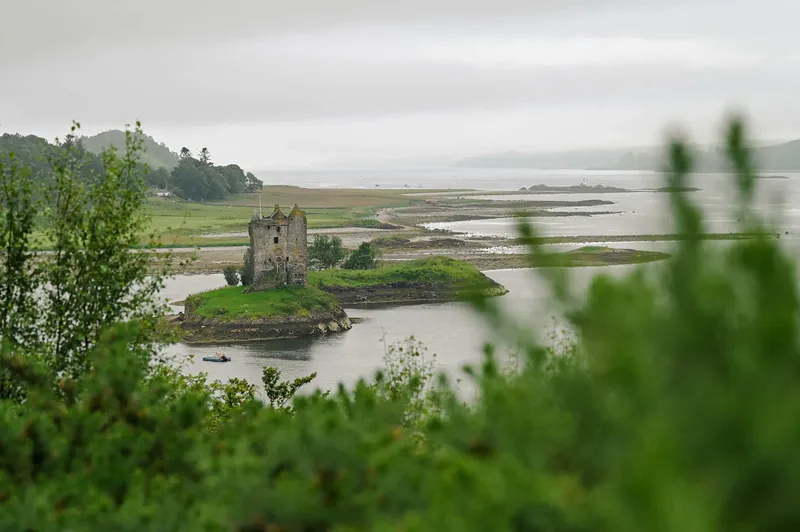
Castle Stalker Viewpoint
💡 Interesting facts about the Castle StalkerCastle Stalker is located on a natural tidal island in Loch Laich, a bay of Loch Linnhe. In the middle of the lake, surrounded by the rugged mountains, the viewer is presented with a picturesque sight that can only be found in the Scottish Highlands. Castle Stalker is in the form of a residential tower and is one of the best-preserved buildings of its type in Scotland. Access is possible by boat and, at low tide, on foot.
Castle Stalker was originally built by the MacDougall clan in the 13th century as a small fortification. Accordingly, the walls of Castle Stalker are the venue for numerous bloody clan feuds, intrigues and campaigns of revenge. The owners changed frequently over the centuries due to defeats and sieges. Castle Stalker was then left to decay in the 18th century. In 1965 it was founded by Lt. Col. D. R. Steward bought it and received an extensive restoration until the owner died in the 1990s.
The walls of Castle Stalker are 2.70 meters thick and the tower house measures approximately 14.8 × 11.8 meters. On the ground floor there are three rooms with barrel vaults and a prison. Above this are two upper floors and a mansard. On the southeast wall of the ground floor is the entrance to Castle Stalker, which is closed with two heavy doors.
Today Castle Stalker is privately owned, but pre-booked tours are run by the owners by appointment. But Castle Stalker also offers an unforgettable sight from a distance, to which the family-run “Café Castle Stalker View Inn” on the nearby hill north of Portnacroish warmly invites you. From which we took this photo. With panoramic views over Loch Laich and Castle Stalker, you can comfortably enjoy midday tea and traditional Scottish meals.
Conversations along the way
Approved comments from the original article, in their original language.
[…] Auf der Weiterfahrt von Mallaig kommen wir nochmal durch Fort William und auch beim Glenfinnan Viadukt nochmal vorbei. Diese beiden Stationen hatten wir ja bereits in unserer ersten Woche am Programm und sind es damals von Haus Nummer 1 in Taynuilt aus angefahren. Gerne könnt ihr dies noch hier nachlesen: Fort William – Glenfinnan Viadukt – Besuch des Hogwarts Express. […]
[…] und Bergsteigen neben Wintersport beliebte Freizeitaktivitäten der Touristen sind, welche oft von Fort William hierher starten.Das Gestein des Glen Coe ist vulkanischen Ursprungs und die zahlreichen Berge und […]